Two nations, two gates, one golden key
TEHRAN — For six months, Washington’s story stayed the same: Iran and its allies are isolated, the resistance is finished, and the oil routes are safe under American control. Trump and his officials claimed all this happened in days, not years.
Ignore the press conferences and look at the map instead. Yemen’s Ansarallah now control Mocha. They hold Dhubab, the last mainland town facing the island across the Bab el-Mandeb strait. They hold Perim, the rocky island that splits the strait into two narrow shipping lanes. The Hanish islands appear to have gone the same way. That would put the entire Yemeni Red Sea coast under one authority.
This is the same movement that was supposed to be wiped out after seven years of Saudi bombing, joint American and British strikes, and Israeli air raids and assassinations. Boats crossed the water. An island changed hands almost overnight.
Mocha is not just a trophy — it is a working port. Dhubab is the last real stretch of mainland facing the narrows. Perim sits in the middle of the Bab el-Mandeb Strait itself: eighteen miles of water squeezed into two tight lanes with a rock in the center. Hold all three and you do not just threaten the strait — you own the checkpoint.
Washington wanted a war short enough to fit a news cycle. Tehran took the first punch, kept its underground capabilities intact, and let the real cost fall later on the Persian Gulf capitals that bankroll the project. What is happening on the Yemeni coast is not a coincidence. It is the second half of the same plan.
A short war favors air power and press briefings. A long war favors whoever is still standing once the cameras leave. Iran and Yemen are still standing.
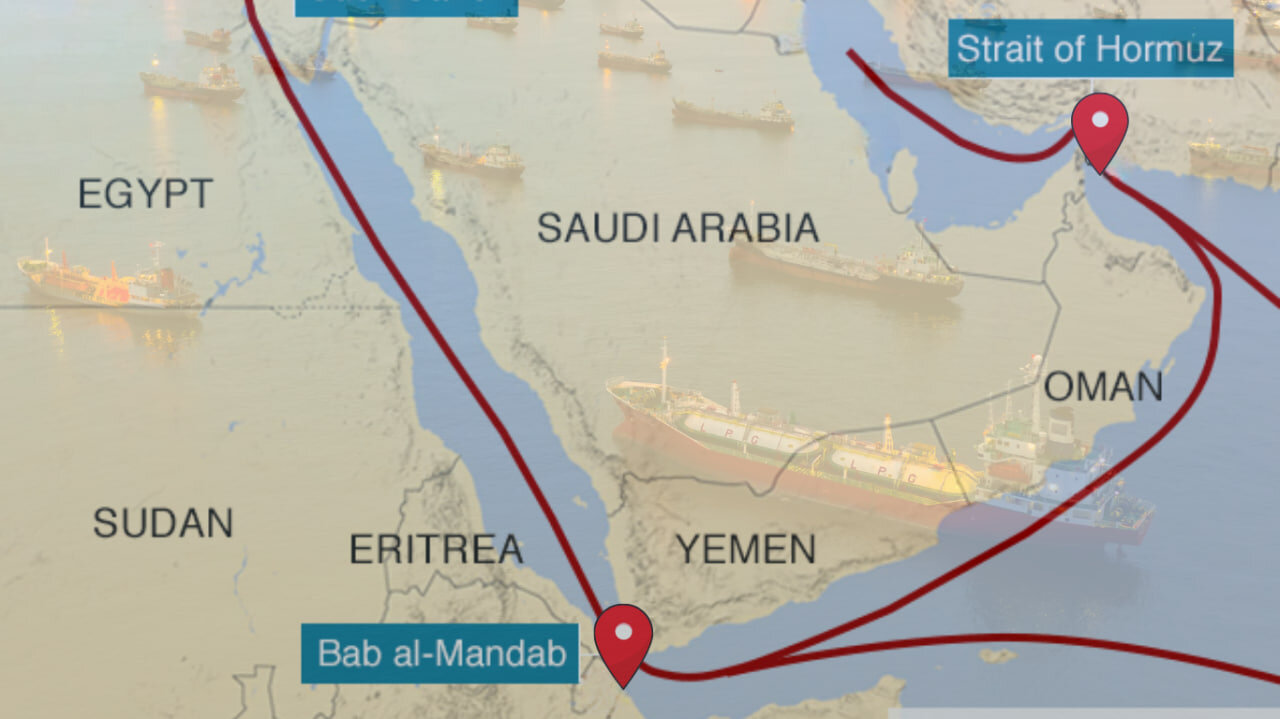
Since fighting with Iran began in February, Washington and Tel Aviv have tried to weaken Iran from the air and sea. Iran’s response stayed simple: no tanker leaves the Persian Gulf without its permission. The Strait of Hormuz stopped being an open shipping lane and became a checkpoint. That pushed Riyadh, Kuwait, and Abu Dhabi onto their backup route — overland to Yanbu, then south through Bab el-Mandeb. That backup route now runs straight past Yemeni-held ground.
Ansarallah closed the loop. Mocha, Dhubab, Perim — three positions, one chokepoint. The backup plan is gone too.
The Persian Gulf has only one real exit. For decades, Riyadh and Abu Dhabi assumed Washington would keep that exit open forever. When that failed, the Red Sea corridor became the fallback. That fallback is now compromised as well.
Tanker lanes were already only a few miles wide. Now they run under the watch of a force that has spent a decade learning this exact stretch of water. The roughly four million barrels a day the Saudis used to reroute around Hormuz now has to cross contested waters. Add the rest of regional shipping and the figure easily reaches six million barrels a day. This is no longer a footnote — it is the headline. Oil is already above $100 a barrel.
Insurance markets will price this risk in long before Washington issues a statement. Shipping companies do not answer to the Pentagon. They reroute, pay higher premiums, or stop sailing. A warship on a map does not set insurance rates. Whoever holds the shoreline and the island does.
American naval doctrine was never really about “freedom of navigation.” It was about keeping navigation under American supervision. When that model breaks at two of the world’s three key chokepoints at once, it is not bad luck. It is the postwar maritime order coming apart.
Malacca is a separate issue for another day. What matters now is that the old belief — that global chokepoints ultimately answer to Washington or its allies in Tel Aviv — has taken a serious hit at both ends of the Persian Gulf’s main export route.
Saudi jets are still flying. Air power is what you use when you cannot hold ground with soldiers. Ansarallah has lived under that air power for more than a decade and kept taking territory anyway. The highlands and the Tihama coast do not empty just because a coalition loses momentum. Bombing a place is not the same as occupying it, and only occupation decides who controls land. Yemen has proven that point more than once.
Part of the reason this offensive did not stall is simple: Ansarallah fighters are defending their own homes, not collecting a foreign paycheck. That gives a person a reason to hold a position after the next round of strikes that a hired fighter never has. On the other side are many people manning checkpoints for a salary, in someone else’s war, supporting a project that will drop them the moment the money runs out.
Officials in Washington will keep talking about naval escorts and “open” sea lanes. The shipping data says otherwise. Hormuz traffic has already dropped sharply and now moves largely on Iran’s terms. Bab el-Mandeb is heading the same way. You can call a strait open all you like — underwriters will not treat it that way if the people who actually hold the coastline say differently.
Ansarallah’s position has been consistent: safe passage for everyone except vessels tied to Saudi Arabia; blockade for blockade; escalation matched with escalation — until the war on Yemen actually ends. That is a stated condition, not an idle threat.
The fallout does not stop at trading desks in London. Egypt depends on Suez Canal revenue. Jordan needs Aqaba running. Israel needs Eilat running. Arab states on the southern side of the Persian Gulf built their financial security on an American security umbrella. Now their only real sea route passes through territory they do not control. Kuwait has almost no alternative and is already boxed in. Cairo cannot create canal traffic out of nothing. Amman cannot move a port. Eilat will not turn into Haifa just because Tel Aviv needs it to.
This was never just a Yemen story. It is a Persian Gulf story that happens to be playing out on the Yemeni coast.
The harder question is what comes next. Persian Gulf capitals built their entire security posture on the idea that Washington’s presence made these waters permanently theirs to use. That idea now has two visible cracks — Hormuz and Bab el-Mandeb — and cracks in shipping insurance do not heal because a general holds a press conference. Trump is reportedly saying the war will wrap up after the midterms; his own people are said to be telling him to plan for years, not months. Sooner or later the real conversation about keeping oil moving will stop being a conversation with Washington and start being one with Tehran and Sanaa, on terms nobody in Riyadh or Washington is used to negotiating.
Whether that ends in a settlement or a long standoff, no one knows yet. What is no longer in dispute is who holds the ground on both ends of the route right now. Six months of claims that Iran and its allies were “isolated,” “degraded,” or “finished” were what officials wanted people to believe. The coastline tells a different story. The oil still has to move, and for the first time in this war, the routes it depends on run through territories Washington does not control.
The message from Hormuz to Bab el-Mandeb is simple: the gates stay open only on the terms of whoever controls them. That is the shift. Everything else is commentary.
Iran holds Hormuz. Yemen holds Bab el-Mandeb. Two nations, two gates, one golden key. And for the first time in decades, Washington — and the project it shields in Tel Aviv — is standing outside the door.